


CAPLINQ has been fielding questions about what exactly the right time is to use carnauba wax aerosol spray. To get better insight into this question, it may be best to start with the opposite question, and work our way back.
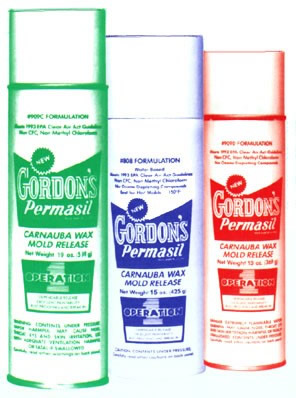
Even before we address this, let me start by saying that carnauba wax, in its solid form is used by most epoxy mold compound formulators as one of the waxes used to prevent mold sticking in the first place, and that carnauba wax itself is then obviously compatible with epoxy mold compounds themselves. Now let’s get back to the question.
In an ideal production environment, the product mix would be low, the volume would be high, and there would be no mold-chase changes, stuck plungers, cleaning or maintenance repair. There would be a single epoxy-mold compound used with the perfect balance of adhesion promoters to stick to the substrate (leadframe or laminate) with the right level of waxes to perfectly release from the mold and not cause any plunger sticking. In a case like this, not only would carnauba wax aerosol spray be unnecessary, mold release products across the board would no longer be needed.
In a flexible, high-mix production environment, sprays will always have a place
Taking it a step toward reality, we’ll throw in that regular cleaning and maintenance are a given and every now and then a plunger may get stuck. Still, the product mix is low and volume is high. In cases like this, the ideal solution would use a transfer moldable mold conditioner after cleaning which is less operator dependent than an aerosol spray. Still, in this case, the carnauba wax aerosol spray would be used to clean the plunger should it stick.
Looking at an even more realistic situation, the production environment has a higher mix-volume, multiple products are made in the same mold and multiple mold compounds are used in the manufacture of the semiconductor devices. Furthermore, mold compound trials to evaluate new products and new designs are tested. In this case, carnauba wax aerosol spray has multiple uses. As before, the product is used to clean stuck plungers, but it should also be used prior to testing of any new products and after each time the mold is cleaned. It is also used to break in new mold tools and return other ones to service after maintenance.
In summary, most production environments would prefer not to use a spray, but the reality is that every production floor DOES use a spray. The sprays used are typically silicone or PTFE (Teflon) based products that are NOT compatible with epoxy molding products. These products then DO contaminate the mold, may cause product delamination and often are very operator sensitive — which is a major reason why manufacturers do look to go to a mold-conditioner type products instead of aerosol sprays.
In these cases, carnauba wax aerosol spray is a much superior (albeit more expensive) product for the following reasons:
- Unlike silicone and PTFE (Teflon) sprays, Carnauba wax aerosol spray is compatible with epoxies and engineering plastics and can also be used for a wide-variety of epoxy types instead of carefully selected mold-conditioner
- Carnauba wax aerosol sprays are flexible because of the compatibility with a wide range of epoxy molding compounds
- The “Green” #909C Carnauba Wax Aerosol Spray uses a “non-flammable” solvent making it safe but rapid-drying
In short, high-volume, single-product molding lines may benefit from moving to a less operator-dependent aerosol spray application; but in a flexible, high-mix production environment, sprays will always have a place, and carnauba wax aerosol sprays are by far the preferred choice in terms of compatibility and performance for both epoxies and other engineering plastics.
CAPLINQ is a specialty chemicals, plastics, and products company that offers a variety of epoxy mold release agents including Chemlinq MRE-C909, MJ Gordon Permasil #909C, and LinqSil S‑100 mold release spray. Please contact us if you have any other questions about Carnauba Wax.


I have just recently purchased a product of cleaning wax. It is basically a waterless wax. I have never come across a product that is so, so good. So good does not really describe this magnificent product. I purchased 2 cans at the time and I have almost gone through all of it. It contains CARNAUBA. Truly a magnificent product.
We are developing a extrusion/molding process for an oral care product, portions of which will ultimately be ingested by the user.
I found your description of your mold release agents interesting. Especially the Water Suspension version (Blue Label package) as it implies a water emulsion of the Carnauba Wax. Is the emulsifier system in the Blue Label suitable for use in a process where it will be in contact with an orally ingested product?
I suppose that is a nice way of asking what else is in the product besides Carnauba Wax that we would need to be concerned about from a regulatory status situation where we would have to disclose all chemicals that might be found in trace quantities upon analysis?
Ira Hill
Co-owner, WhiteHill Oral Technologies, Inc.
Dear Dr. Ira Hill,
It is a nice way of asking indeed, and in return I will offer a nice answer!
There are only three ingredients in the MJ Gordon Carnauba Wax:
1 — Water (Approx. 69% by weight)
2 — Dimethyl Ether (Approx. 30% by weight)
3 — Carnauba Wax (Approx. 1% by weight)
The Dimethyl Ether is used as the propellant (non CFC of course). As far as disclosing chemicals for regulatory purposes, of course we must also comply. The complete Material Safety Data Sheet (MSDS) for Gordon’s Permasil #808 Carnauba Wax Mold Release
(Blue Label) can be found on MJ Gordon’s Website.
Dear sir very useful informations about carnauba wax as a mold releasing agent, i want to use carnauba wax in aerosol as a furniture polish please guide me for this application. Thank you.
Muhammad,
Carnauba Wax has many applications and as you have understood, CAPLINQ are experts in the use of Carnauba Wax Aerosol Sprays as mold release agents for semiconductors and other critical applications.
Though Carnauba Wax is used in furniture polish, it is often one of the raw materials used in combinations with bee wax (as described here) due to its higher melting point, and not as the sole ingredient.
We do not profess to know if Carnauba Wax alone is suitable as a furniture polish, but if you have previously successfully used a solid version of carnauba wax for this purpose, then an aerosol version is available in one of our MJ Gordon’s Carnauba Wax Aerosol Sprays.
Do you think we can use carnauba wax in aerosol to seal copper jewelry? We are desperate trying to find a way to make anti tarnish copper jewelry. Thank you very much
This is a question we can’t answer. If carnauba wax is what you need to make an anti-tarnish product, then yes. Unfortunately, we don’t have much expertise in the area of jewelry making, so we cannot advise whether carnauba wax (aerosol or otherwise) is suitable to your process.
Dear Sir /Madam,
Could you tell me whether the Gordons Carnauba Wax Aerosols comply with the European Aerosol Dispensers Directive 75/324/EEC, there is no information on the cans like the reversed epsilon to say they do.
I’m sorry, I am not 100% sure whether the MJ Gordon Carnauba Wax #909C Green does or not. We do supply it extensively through Europe and use PostNL (formerly TNT Post) for delivery without any issues.
Hello Sir/Madam,
Could you tell me if Gordon carnauva wax has an effect on plastics or metals when using on the temperature ranges 180–190 degress celcius? Because recently 1 of the products in the company that I was working encountered discoloration on the baseplate of theproducts. I am wondering if carnauva wax has an effect on the problem that encountered recently or if excessive application of carnauva wax has an effect while the products was soaked at the M‑pyrol solution.
It is very unlikely that the carnauba wax caused any discoloration. It is used often on all sorts of plastics and metals, and there is no interaction between the two that would cause discoloration. What is more likely is that the SOLVENTS within the carnauba wax spray could have caused this. Carnauba wax itself is non-aggresive, but it is a solid. In order to make this product liquid to be able to apply it, it needs to either be heated up, or emulsified, which is a process that adds solvents to make the carnauba wax liquid at room temperature. The products we sell contain a non-flammable solvent to emulsify the carnauba wax which has a similar neutral effect on plastics and metals.
Hi,
We have encountered visible contamination on the baseplate after soaking to heated M‑pyrol and the only material added during molding the is the carnauba wax(aerosol). Can M‑pyrol wash-off carnauba wax? I have read that M‑pyrol is a polymerization medium for polyester, would this mean that instead to be removed carnauba wax tend to make a polymer/chain/cross-link that adhere on the baseplate?
It is not impossible that the carnauba wax is absorbed into the matrix of the product upon cure. Typically, carnauba wax is used in a number of thermoset materials to provide a “self-release” mechanism to release the thermoplastic after cure. However, the levels of carnauba wax used within these materials is normally quite low, much less than 1%. In aerosol form, the carnauba wax is present locally at a much higher level, so it is unlikely that it is all absorbed into the M‑pyrol matrix. This said however, we do not have experience with M‑pyrol, so we can comment on this specific substance specifically. Hope this helps you fix your issue.
Hi! does your product is really safe? because I saw in the label that your product is containing a chemical which is known to the State of California that is causing birth defect and other reproductive harm to human.