
Diodes
Axial, Schottky and SOD
- Home

- Semiconductors
- Diodes
- Small Outline Diodes (SOD)
Small Outline Diodes (SOD)
Small Outline Diodes
Small outline diodes (SODs) refer to a group of semiconductor packages that are surface-mounted diodes. SODs are smaller, more compact than regular diodes, and they are designed in such a way that they can be automatically assembled onto surface mounted boards.
There are multiple variations of small outline diodes, including SOD-123, SOD-523, and SOD-923. The numbers and letters in the name typically refer to the package’s physical attributes, including their size. SOD-123 is the largest diode in the family while SOD-923 is the smallest. Some packages will also have “F” or “FL” in their names, indicating a flat lead.
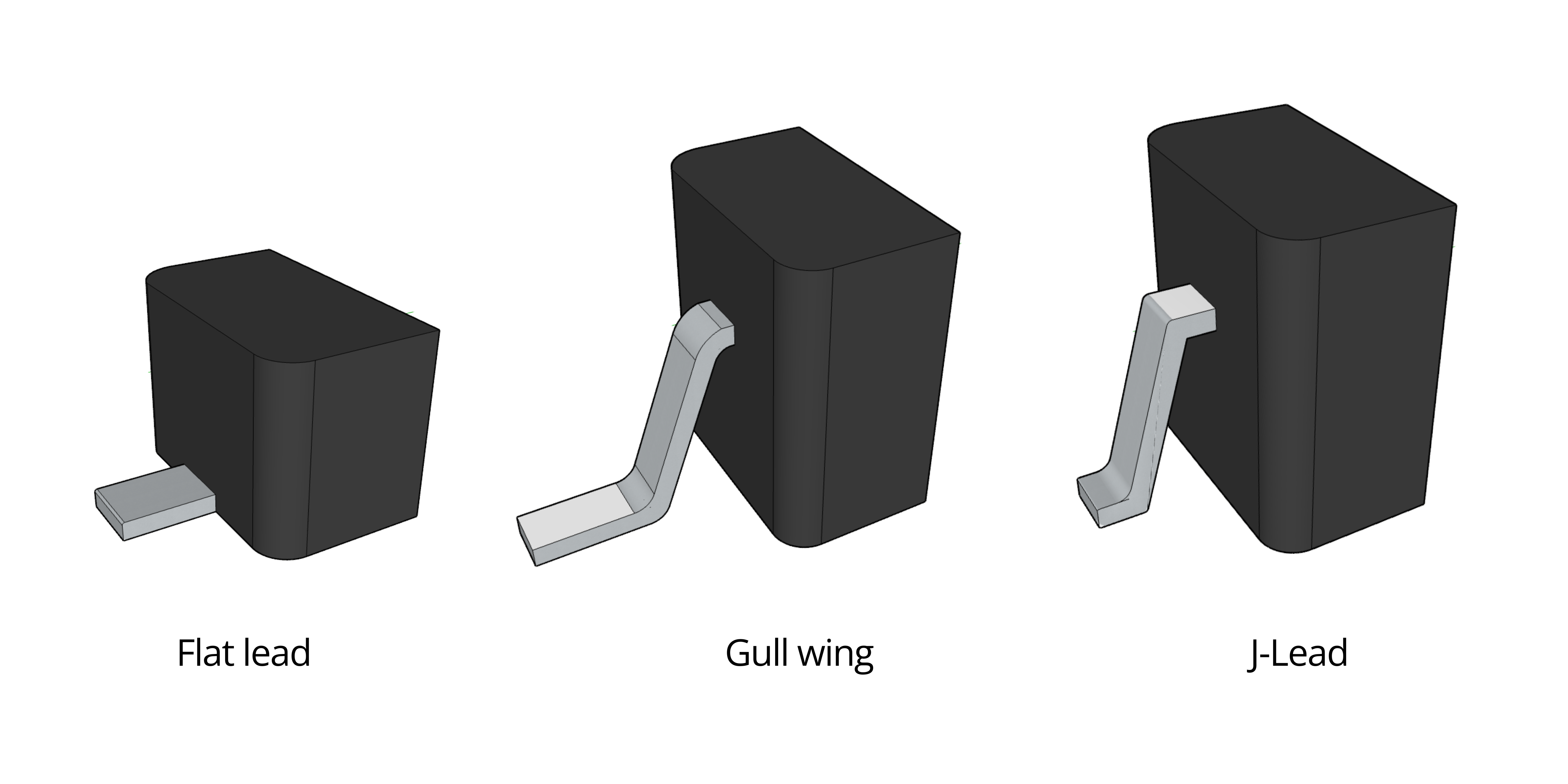
There are three general types of SODs based on their leads: gull wing, flat lead, and J lead:
Flat Lead: a metal lead that extends straight out from the side of the SOD package and parallel to the PCB when mounted. Flat lead SODs are typically used for applications requiring a straight connection.
Gull wing: this type of lead bends down then spreads away from the SOD package, resembling bird wings, hence the name “gull.” Its shape allows for solid footing to the PCB during assembly. SODs with this type of lead are more fragile and less space efficient compared to those using a J-lead. Gull-wing SODs are also cheaper but easier to work with should hand soldering be needed.
J-Lead: a metal that bends down to the bottom of the SOD package, forming a letter “J.” J-lead SODs are used for applications requiring board space efficiency, lower profile, and resistance against mechanical stresses.
Small outline diodes function like any regular rectifier diode: when positive voltage that meets the minimum threshold requirement (around 0.7V for silicon diodes) is applied to the p-side (anode), the potential barrier decreases, allowing current to flow through. On the other hand, when negative voltage is applied to the p-side, the potential barrier increases and diodes block the flow of current. Some packages have Schottky Diodes packaged in SOD-123, SOD-323, and SOD-523 variants.
SOD’s special feature is that it is small and compact, that it reduces package volume of SMT packages, and that it can be automatically assembled onto the board.
Applications of SODs
Small outline diodes can be used in surface mount technology packages that are
- Consumer electronics
- Renewable energy
- Wearable devices
Consumer Electronics
SOD packages serve a wide variety of functions in consumer electronics assembly:
| Function | Description |
| Rectification | SODs are commonly found in smartphone adapters, TVs, and audio systems. They convert AC to DC for power supplies. |
| Signal Demodulation | SODs also extract audio or data from modulated signals in receivers. |
| Voltage Regulation & Device Protection | SOD packages stabilize voltage in circuits, as an added layer of protection for voltage-sensitive components. Transient Voltage Suppression (TSV) diodes in SOD packages also provide device protection against electrostatic charges. TSV diodes are usually found in connectors and ports. |
| Switching | Fast-switching SODs handle high speed signals in microcontrollers and logic boards on mobile devices. |
| Power Management | Schottky diodes in SOD packages reduce power loss due to their low forward voltage drop, making battery usage more efficient in mobile devices. |
Renewable EnergySOD packages also provide switching, rectifying, device protection, and power management capabilities in applications related to renewable energy. However, an added application of this diode package is that they are also found in DC-DC inverters in solar & wind power systems, and that they manage power flow in Maximum Power Point Tracking (MPPT) controller circuits. MPPT controllers connect solar panels to DC-DC converters. When a panel experiences voltage drops, diodes (typically Schottky) packed in SOD package block reverse current from flowing back into the panels, preventing energy loss. SOD Schottky diodes also ensure that there is minimal power loss because of its lower forward voltage versus Si diodes. | Wearable DevicesLikewise, SOD’s functions in wearable devices and consumer electronics are highly similar; however, an added application under this classification of devices is that SODs are used as photodiode arrays for heart rate monitoring and optical sensors. Photodiodes convert light to electrical current. Light is shone through the skin, and the light absorbed and reflected by the skin fluctuates due to blood flowing. These fluctuations are detected by photodiodes which are then translated to electrical current that are then processed then displayed on wearable devices’ screen. SOD-123 and SOD-323 are typically the packages used in this application. |
Design Challenges in Small Outline Diodes
Because of its compact size, one of the key considerations when designing and selecting the right material for small outline diodes is thermo-mechanical stress from the die bonding process as well as the molding process brought by coefficient of thermal expansion (CTE) mismatch between the die and the components of the package.
A buildup of thermomechanical stress can yield to die cracking. This is a common problem in the electronics industry and if left unaddressed, it affects the performance and reliability of electronic devices.
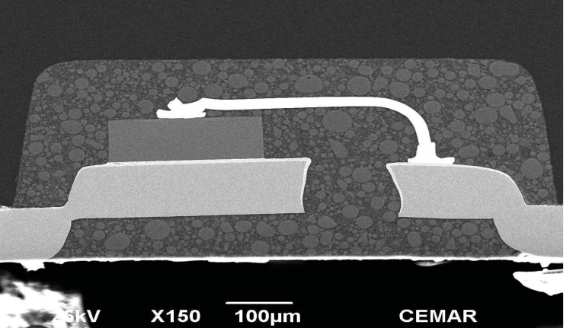 (Adapted from Shi et. Al., 2012)
 Low stress & low warpage to better manage thermo-mechanical stress buildup
Superior adhesion onto the lead frame and the die surface to prevent delamination and potential moisture contamination
High spiral flow & low viscosity both of which will ensure that the mold cavity for smaller packages such as SODs are filled and void-free.
Low ionic content to prevent corrosion and current leakage in the diode.
Excellent electrical insulation
Hysol EMC Selection Guide for SOT, SOD, and Related Small-Outline Discrete Packages
This guide helps identify suitable molding compounds for SOT, SOD, and related small-outline discrete packages based on package size, electrical demand, mechanical stress sensitivity, and assembly process needs. The highlighted rows at the bottom distinguish broader Hysol portfolio options that are primarily optimized for IC or power packages, rather than standard SOT/SOD discrete applications.
| Product | Key Benefit | Typical Use Case |
|---|---|---|
| Hysol GR510 | Larger or stress-sensitive packages Low thermal expansion and moisture resistance help reduce mechanical stress | Larger SOT or SOD packages where package integrity and long-term reliability are important |
| Hysol GR510-HP | Larger or power-oriented packages Enhanced electrical insulation combined with very low expansion | Larger-body or power-oriented discrete packages requiring robust electrical performance |
| Hysol GR640HV | General-purpose balanced solution Proven reliability at high reflow temperatures with good electrical insulation | Mainstream SOT, SOD, and SMX packages requiring stable, all-around performance |
| Hysol KL6500S | Stress-control focused solution Low stress characteristics support package and die reliability | Small-outline transistors or diodes where stress control is a priority |
| Hysol GR646 | Throughput-focused option Fast curing supports high-volume manufacturing | High-throughput SOT / SOD transfer molding operations |
| Hysol GR640HV-L1 | Electrical performance and eutectic compatibility Stable electrical insulation with high moisture-resistance classification | SOT or SOD packages requiring strong electrical margin and eutectic attach compatibility |
| Hysol GR640HV-L1 (M7A) | Enhanced electrical robustness Further enhanced electrical performance stability | Applications requiring additional electrical robustness beyond standard L1 options |
| Hysol GR640HV-LV | Wire-sensitive molding control Optimized mold flow helps protect fine or long wire configurations | Small-outline packages where wire integrity during molding is critical |
| Hysol GR640HV-FF | Ultra-small and fine-feature packages Fine filler design supports very small cavities and fine features | Ultra-small SOD packages such as SOD-923 or similar miniaturized formats |
| Hysol GR720 | Die attach paste compatibility Designed to work well with paste-attached dies while managing stress and delamination | Selected SOT and SOD packages using die attach paste bonding |
| Hysol GR710F | Broader portfolio option, optimized primarily for IC-style packages Balanced halogen-free option typically used for IC-style package families | Typically selected for SOIC, TSOP, SSOP, and selected TO formats. Consider for SOT/SOD only in specialized cases. |
| Hysol GR700-P2 | Broader portfolio option, optimized primarily for power packages Electrical and high-voltage focused option for more demanding power-package conditions | Typically selected for high-voltage and wide-bandgap power packages such as TO-247 and TO-252. Consider for SOT/SOD only in specialized high-voltage cases. |
Frequently Asked Questions About Small Outline Diodes
▶ What is the difference between SOT and SOD packages?
SOD stands for Small Outline Diode, while SOT stands for Small Outline Transistor. In practical semiconductor packaging, SOD packages are typically used for discrete diode devices such as rectifier, Schottky, switching, or TVS diodes, while SOT packages are more commonly used for transistors and other small signal or power devices.
SOD packages usually have 2 terminals, matching the two-electrode structure of a diode. SOT packages more often have 3 or more leads, depending on the device function and package style.
While SOT packages were originally defined for transistors, the package format is also used for certain regulators, ESD devices, and other small multi-function semiconductor components.
▶ Why do most SOD packages only have two leads?
Most SOD packages contain a single discrete diode die, and a diode fundamentally requires only two electrical connections: anode and cathode. Because of this, the package structure is optimized for compact size, simple leadframe design, and efficient high-volume transfer molding.
This two-lead format helps reduce package footprint and material usage while maintaining the electrical and thermal performance needed for compact surface-mount applications.
▶ What are common SOD package types?
Common plastic surface-mount SOD package families include SOD-123, SOD-323, SOD-523, and SOD-923. These package names generally refer to very small diode outlines used where PCB area is limited and low-profile assembly is required.
As package size becomes smaller, mold compound flow, filler cut, die protection, package handling, and board-level reliability become more critical during transfer molding and downstream assembly.
▶ What epoxy molding compound properties matter most for SOD packages?
For SOD packages, important epoxy molding compound properties typically include good fillability, controlled viscosity, fine filler cut, low moisture absorption, strong leadframe adhesion, and stable electrical insulation and dielectric performance. These characteristics help support complete cavity fill, minimize defects, and improve resistance to delamination during reliability testing.
Depending on the diode type and application, additional priorities may include MSL performance, HTRB capability, thermal stability, low internal stress, and compatibility with Cu, Ag, or Ni-plated leadframes.